27-28th October 2026
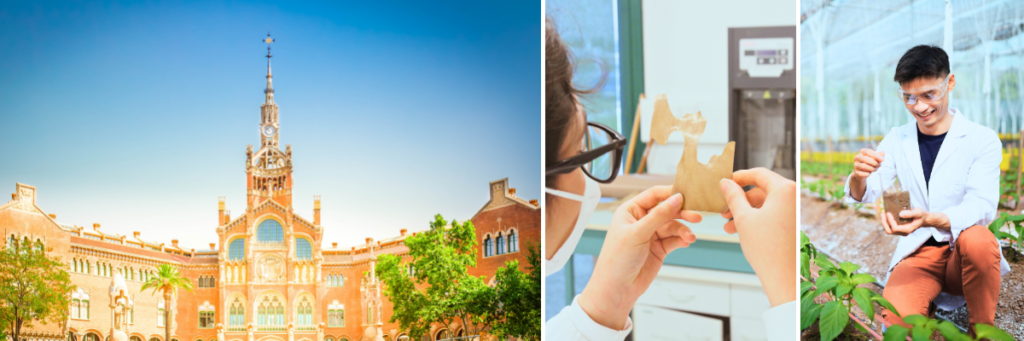
Sant Pau, Barcelona
From agricultural residues to high-value solutions: Join us in Barcelona to experience the culmination of four years of international innovation.
Please note, this event is free to attend. Lunch and refreshments throughout the day will be provided. Accommodation, travel and other meals etc should be covered at your own expense.
Registration are now closed, please contact agriloop-it@inrae.fr if needed
What can you expect?
Inspiring sessions and demonstrations on how residues can be transformed into biodegradable plastics, biobased chemicals and sustainable proteins.
Policy conversations that put farmers and the biobased industries that support them at the centre of a bioeconomy.
Connect and collaborate with farmers, industries, researchers and policymakers driving global change.
Who should attend?
Industry, farmers, end users, policymakers, researchers
Conference programme
Please note, all times listed below are Central European Time (CET). Sessions will be delivered in English with the exception of the live YouTube section, which will be in French with some interactive elements translated (please see below for full details). Download the full agenda here.
| Time | Session | Speakers/Moderators |
|---|---|---|
| Day One — 27 October 2026 | ||
| 12:00–14:00 | Registrations and networking lunch* Exhibition on AgriLoop value chains, card game and networking. | |
| 14:00–14:10 | Welcome and introduction to AgriLoop’s circular agriculture design Creating integrated biorefineries to convert agri-residues into novel opportunities. | Nathalie Gontard, Project Coordinator (EU) and Research Director, National Research Institute for Agriculture, Food and Environment (INRAE), France Aimin Shi, Project Coordinator (China), Professor, Institute of Food Science and technology, Chinese Academy of Agricultural Sciences (IFST-CAAS), China |
| 14:10–14:50 | Managing agricultural residue circularity: pathways to gold? This session explores the opportunities, environmental benefits and pitfalls of reusing agricultural residues circularly. Drawing on stakeholder suggestions, it quantifies the potential of selected opportunities, highlights possible hazards in chosen residue-to-product pathways, and demonstrates their environmental benefits. It closes with recommendations and an open discussion on how to identify circular opportunities in general, and why situation-specific hurdles must be considered. | Jan Broeze, Wageningen Research, the Netherlands Miguel Mauricio, University of Santiago de Compostela, Spain Gang Li, Beijing Technology and Business University, China |
| 14:50–15:30 | Unlocking biomass value through cascade extraction: from concept to reality After introducing Agriloop’s work on recovering proteins and valuable natural chemicals from agricultural residues, the session will discuss how to unlock their value in China, exploring cutin value chains from plant protection to functional materials. It will then introduce the “two-phase, double value” eco-recovery of phenolics and carotenoids using biphasic NADES. It closes with an open debate on no waste, just value: the next steps for agricultural biorefineries under safe-and-sustainable-by-design principles. | Chahinez Aouf, INRAE, France Hui Hu, IFST-CAAS, China Nadia Ribeiro and Cristina Silva Pereira, Universidade NOVA de Lisboa, Portugal Annalisa Tassoni, University of Bologna, Italy |
| 15:30–16:00 | Break and networking | |
| 16:00–17:00 | Closing the loop: advanced biological strategies for converting agri-residues into microbial protein and polyhydroxyalkanoates (PHAs) This session will highlight recent advances in the sustainable bioconversion of agricultural residues into high-value products, specifically microbial protein and polyhydroxyalkanoates. It will explore key innovations across the whole process chain: feedstock pretreatment, advanced fermentation strategies, efficient product recovery and purification, and the use of mathematical modelling for process optimisation. An open discussion working with the public on the next steps to be set up plus audience questions will close this session. | Wei Gao, Institute of Agricultural Resources and Regional Planning of the Chinese Academy of Agricultural Sciences (IARRP-CAAS), China Miguel Mauricio, University of Santiago de Compostela, Spain Maria Reis, NOVA School of Science and Technology, Portugal Marianna Villano, University of Roma, Italy |
| 17:00–17:40 | Agro-residues valorisation into new sustainable bioproducts: pilot scale experiences Agriloop turns promising value chains for valorising agri-waste into tangible applications. This session illustrates several pilot-scale alternatives and shares the lessons learned and challenges met while scaling up technologies and developing sustainable alternatives from agricultural residues. The focus is on microbial proteins for feed, cutin and composite PHA-based materials for agricultural use in the context of the EU and China. A panel discussion will wrap up the session, asking: from pilot success to market reality, what are the remaining challenges? | Hélène Angellier-Coussy, University of Montpellier, France Tommaso Barbieri, TomaPaint, Italy David Bolzonella, UNIVR, Italy Filip Miketa, Bio-Mi, Croatia Kim Windey, Avecom, the Netherlands Yao Xiaolong, Beijing Technology and Business University, China |
| 17:40–18:00 | Concluding remarks and reflections from Day One | Nathalie Gontard, INRAE, France Aimin Shi, IFST-CAAS, China |
| 18:30–19:30 | Live YouTube Q&A with farmers and agroecology stakeholders This session follows up on the video “A farm fighting to eliminate plastic with scientists tackling the challenge,” produced by journalist Pierre Girard. Open to all. The discussion will be in French but questions and comments in other languages from the live participants will be translated. | Pierre Girard, Journalist, Arte, TousTerriens, France Hélène Angellier-Coussy, University of Montpellier, France David Bolzonella, University of Roma, Italy Nathalie Gontard, INRAE, France Jan Linck and Burkhard Schaer, ECOZEPT, Germany/France |
| Day Two — 28 October 2026 | ||
| 09:00–10:30 | External keynote speakers and views | |
| Engineering and building demo and industrial scale bio-refineries on various feedstock, processes and products – lessons learned | Wolfgang Ranfft, VP Bio Based Products, De Smet Engineers & Contractors (DSEC), Germany | |
| Bioplastics from biowaste: regulatory, technical and market landscape | Mauro Majone, SiPHA, Italy | |
| Closing the loop with insects: advances and challenges in insect bioconversion | Christos Rumbos, University of Thessaly and CIPROMED project, Greece | |
| Efficient bioconversion of agricultural and forestry waste into microbial protein | Wei Gao, IARRP-CAAS, China | |
| 10:30–11:00 | Break and networking | |
| 11:00–13:30 | Workshops (choose one of the three options detailed below) | |
| Workshop 1: From residues to revenue—making new sustainable value chains work for industry and farmers The session will produce concrete assumptions, conditions, barriers and recommendations to feed into the afternoon roundtable. Objectives: – Co-develop a simplified ‘Residues-to-Revenue Canvas’ to identify what makes residue-based value chains work for both industry and farmers. – Use the canvas to make success factors, critical assumptions, risks and validation needs visible. – Identify what farmers and cooperatives would need to accept the new solution. – Clarify market, operations, cost, risk and governance conditions for scale-up. – Distil success factors, open assumptions and recommendations. | External challenge voices: René Rozendal, Paques Biomaterials, the Netherlands Thomas Guillard, Industrial Design – La Moricière, France Moderators: Jan Linck and Burkhard Schaer (ECOZEPT); Gemma Gandia and Clara Fullana Pons (Federació de Cooperatives Agràries de Catalunya) | |
| Workshop 2: Next generation proteins for a growing world The session will engage the participants in a thought-provoking exploration of how sustainable proteins can help meet the challenges of a growing and changing world. Objectives: – Identify promising next-generation protein sources for sustainable food and feed production. – Share recent advances in the extraction, valorization, and application of alternative proteins. – Evaluate the benefits and challenges associated with scaling novel protein solutions. – Understand key safety aspects, including allergenicity, to support responsible innovation and consumer trust. | External challenge voices: Christos Rumbos, University of Thessaly | CIPROMED project, Greece Laura Cavallarin, CNR | CIPROMED project, Italy Moderator: Annalisa Tassoni (University of Bologna, Italy) | |
| Workshop 3: No time to waste in addressing plastic particles in agriculture This session will explore the sources, impacts, and mitigation of plastic particles in agricultural systems. Objectives: – Learn how plastic particles enter and accumulate in agricultural soils – Understand the consequences on the safety and valorisation of agricultural residues – Explore methods for assessing the environmental impact and footprint of plastic particles – Discover the type of solutions AGRILOOP is offering to mitigate plastic particles | External challenge voices: Adrian Grunder, Bern University | MINAGRIS project, Switzerland Brais Vazquez, University of Santiago de Compostela | ECOPOLYVER project, Spain Valérie Guillard, University of Montpellier and PLASTIPRINT project, France Moderator: Joëlle Housmans (INRAE, France) | |
| 13:30–15:00 | Lunch* and networking Poster presentations of AgriLoop’s PhD and postdoc researchers; learn more about the project’s main value chains. | |
| 15:00–17:30 | Roundtable discussions Roundtable involving the whole room on the key questions arising from the three workshops on markets, proteins and plastic, and in particular about how to benefit from identified opportunities while tackling risks and bottlenecks. The session begins with a quick round of feedback from each workshop lead. | All workshop participants and leaders Moderators: Pierre Girard, Journalist, Arte, TousTerriens, France Aimin Shi, IFST-CAAS, China Nathalie Gontard, INRAE, France |
| 17:30–18:00 | Conference closing Final remarks, followed by farewell games open to all delegates. | |
| 18:00–20:00 | Evening networking drinks Make those last-minute connections over a complimentary aperitivo. | |
*Lunch is provided free of charge for registered attendees.
Registration are now closed, please contact agriloop-it@inrae.fr if needed