
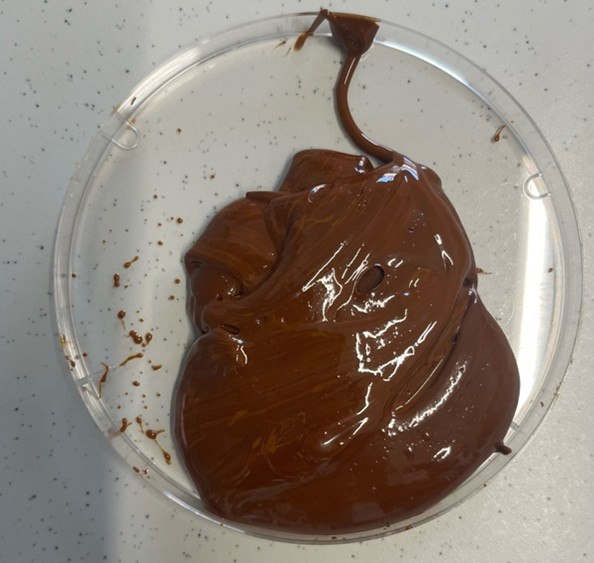
Agricultural and unused residues are rich in natural compounds that can be extracted through green chemistry and have the potential to substitute petro-sourced ones. While Italy is a country producing a huge amount of tomato by-products, is it possible to extract from the peels, a polymer which has the potential to replace plastics!
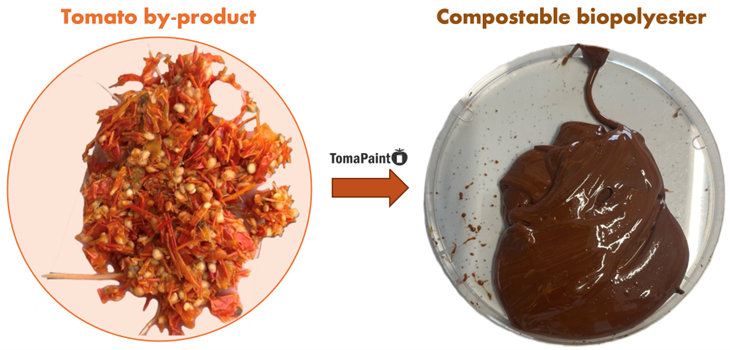
Tomapaint, a startup created in 2019 in Italy, partner of the AgriLoop project. The main objective of the company is the industrialization and the commercialization of a natural bio-resin, called cutin, obtained from industrial tomato processing by-products. The aim of our project is to valorize agricultural residues, especially tomato peels, through a green process, in order to develop a bio-resin that can then be used for diverse applications, such as cosmetics or packaging, substituting traditional petrol-based components.
Polymers are everywhere
Petrol-based polymers are omnipresent in our daily life in a huge panel of applications, such as food and beverage packaging and agricultural practices. Therefore, it is crucial to develop more sustainable alternative, minimizing the use of limited resources and the spread of persistent molecules in the environment. To face this, we extract a natural polyester (cutin) which is expected to take a part in this next generation of materials.
In the context of our study, we produce a natural polyester through a chemical but organic-solvent free hydrolysis. Our analyses showed that the developed process is reproducible and enables the production of a polyester with interesting properties such as hydrophobicity (barrier to water), showing a significant potential to develop alternative materials with the same performances as their current counterparts.
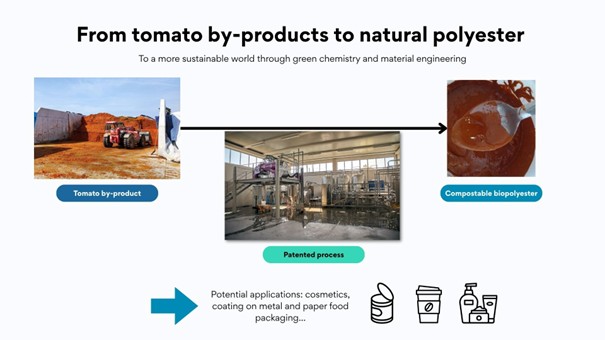
This research aims to improve future daily life by taking a part in circular economy. Developing more sustainable alternatives to substitute current and controversial materials is expected to help reducing environmental pollution by minimizing the extraction of fossil-resources and the emission of persistent particles.
Our natural polyester can be the basis for the production of an innovative bio-lacquer which can be used for the coating of food metal and paper packaging
Natural polyesters extracted from renewable agricultural residues can be used in a wide range of applications, such as cosmetics, lacquers and food packaging. Many of these products are single-use, which requires constant production and puts pressure on fossil resources and pollutes the environment. Our research is helping to solve the scientific bottleneck relative to industrial-scale production/commercialization of a natural polyester, which can then provide benefit for both society and the environment.
How could it change our lives in the future
Although people are willing to enter a more sustainable system, most of the time they are not ready to drastically change their habits (e.g., to ban single-use products). Therefore, developing alternatives that are more sustainable while offering similar products with similar properties may help the system change more efficiently.
To learn more about us: https://www.tomapaint.com/ ; https://www.linkedin.com/company/tomapaint/
by Isabelle Dedieu (Postdoc) at Tomapaint, member of the EU project AgriLoop